
AI Question Generator: Create High-Quality Questions in Seconds
TL;DR: An AI question generator uses natural language processing to analyze content and automatically create multiple-choice, true/false, short-answer, and open-ended questions. This guide covers how the technology works, who benefits most, what to look for when choosing a tool, and how to get the best results – whether you’re working from PDFs, articles, notes, or training documents.
Introduction
Writing good questions is harder than it looks. A well-constructed multiple-choice question one with a clear stem, one unambiguously correct answer, and plausible distractors that reveal genuine misunderstandings takes roughly 2–3 minutes to write. A 25-question assessment adds up to over an hour of focused work. And that’s before you factor in aligning questions to learning objectives, balancing difficulty, and peer review.
An AI question generator solves this bottleneck by using artificial intelligence to analyze your content and generate relevant, well-structured questions in seconds not hours.
In this guide, you’ll learn how AI question generation technology works, the research behind why quizzing improves learning outcomes, which formats are supported, and how to quickly turn any content into an engaging assessment.
An AI question generator solves this bottleneck by using artificial intelligence to analyze your content and generate relevant, well-structured questions in seconds not hours.
In this guide, you’ll learn how AI question generation technology works, the research behind why quizzing improves learning outcomes, which formats are supported, and how to quickly turn any content into an engaging assessment.
What Is an AI Question Generator?
An AI Question Generator is a tool that uses natural language processing (NLP) and machine learning to read, understand, and convert content into structured quiz questions automatically.
Instead of manually combing through documents to identify testable concepts, you provide the source material a PDF, article, study guide, training manual, web page, or raw text and the AI identifies key facts, definitions, relationships, and learning objectives. It then generates questions that reflect the actual content, not generic templates loosely tied to your topic.
Most modern AI question generators support multiple output formats:
Instead of manually combing through documents to identify testable concepts, you provide the source material a PDF, article, study guide, training manual, web page, or raw text and the AI identifies key facts, definitions, relationships, and learning objectives. It then generates questions that reflect the actual content, not generic templates loosely tied to your topic.
Most modern AI question generators support multiple output formats:
- Multiple-choice questions with configurable answer counts and plausible distractors
- True-or-false questions for quick knowledge checks
- Short-answer and fill-in-the-blank questions that test recall, not just recognition
- Multi-select questions where more than one answer is correct
- Open-ended questions for deeper assessment of understanding
- Full practice assessments with scoring, feedback, and result tracking
This makes them valuable for educators, students, corporate trainers, HR teams, instructional designers, and course creators who need to scale assessment creation without sacrificing question quality.
Why Use an AI Question Generator?
Question creation is one of the biggest unaddressed bottlenecks in education and training. Research from the Brandon Hall Group found that organizations using technology-enabled assessments see a 38% improvement in knowledge retention compared to passive instruction alone – yet most educators and trainers spend more time writing questions than they do analyzing results.
An AI question generator changes that equation.
An AI question generator changes that equation.
Save Hours of Manual Work
Writing one high-quality multiple-choice question takes 2–3 minutes. A 30-question quiz from a 40-page training document can take 90+ minutes to build from scratch. AI-powered tools can generate a complete draft quiz in under 60 seconds, cutting question-creation time by over 90%. The time you save goes back into teaching, coaching, and analyzing learner performance – higher-value activities than typing out answer choices.
Improve Learning Outcomes Through Active Recall
A 2013 meta-analysis published in Psychological Science in the Public Interest reviewed hundreds of learning technique studies and concluded that practice testing (active recall) is one of the two most effective learning techniques – significantly outperforming re-reading, highlighting, and summarization (Dunlosky et al., 2013). Questions force learners to retrieve information from memory rather than passively recognize it, which strengthens long-term retention.
A separate study published in Science found that students who took practice tests retained 50% more information one week later compared to students who studied by re-reading the same material (Karpicke & Blunt, 2011). The mechanism is well-established: retrieval practice consolidates memory traces. AI question generators make it practical to create retrieval practice opportunities for every piece of content, not just the ones you have time to write questions for.
A separate study published in Science found that students who took practice tests retained 50% more information one week later compared to students who studied by re-reading the same material (Karpicke & Blunt, 2011). The mechanism is well-established: retrieval practice consolidates memory traces. AI question generators make it practical to create retrieval practice opportunities for every piece of content, not just the ones you have time to write questions for.
Scale Assessment Creation Without Scaling Effort
For organizations that train hundreds of employees, institutions with dozens of courses, or content creators producing multiple learning modules per month, manually writing assessments for every piece of content is logistically impossible. An AI question generator lets you produce assessments for multiple documents simultaneously – consistently and at scale.
Support Multiple Content Types
Unlike PDF-only quiz tools, a general AI question generator works across formats: PDFs, Word documents, web articles, study notes, training manuals, textbook chapters, and raw text. This matters for teams that work with diverse content sources a corporate trainer pulling from PDF policies, web-based regulations, and internal wiki pages shouldn’t need three different tools.
Identify Knowledge Gaps Systematically
Well-designed questions surface which concepts learners understand and which need revisiting data that’s invisible during passive reading or lecture attendance. In corporate compliance contexts, this translates directly to fewer on-the-job errors and auditable proof of understanding. In educational settings, it enables targeted remediation instead of blanket re-teaching.
How an AI Question Generator Works
Modern AI question generators follow a five-step process. Here’s what happens after you provide content:
Step 1: Provide Your Content
Input options typically include uploading a PDF, pasting text directly, entering a URL, or submitting documents in common formats (DOCX, TXT, PPTX). Most tools support files up to 50–100MB and handle multi-page documents without issue.
Step 2: AI Parses and Understands the Content
The system extracts text from your source material, identifies the document structure (headings, sections, paragraphs), and uses natural language processing to understand relationships between concepts. It distinguishes main ideas from supporting details, flags definitions and key facts as high-priority question material, and maps concepts to learning objectives where the document structure makes them explicit.
Step 3: Questions Are Generated
The AI creates questions mapped to the most important content in your source material. For multiple-choice questions, modern systems generate plausible distractors (wrong answers) by drawing from related-but-incorrect concepts in the text producing more effective test questions than random incorrect options that learners can dismiss trivially.
Research from Google DeepMind (2024) on question generation benchmarks shows that state-of-the-art models can produce questions rated as indistinguishable from human-written questions in blind evaluation when working with well-structured source material.
Research from Google DeepMind (2024) on question generation benchmarks shows that state-of-the-art models can produce questions rated as indistinguishable from human-written questions in blind evaluation when working with well-structured source material.
Step 4: Review and Customize
You review the generated questions, edit wording where needed, remove questions that don’t align with your learning objectives, adjust difficulty levels, and reorder the quiz. Most tools allow you to change question types post-generation (e.g. convert a multiple-choice question to a short-answer format).
Step 5: Share or Export
Publish the quiz online, share a direct link with learners, embed it in an LMS, or export in formats compatible with platforms like Canvas, Moodle, Google Classroom, or SCORM-compliant systems.
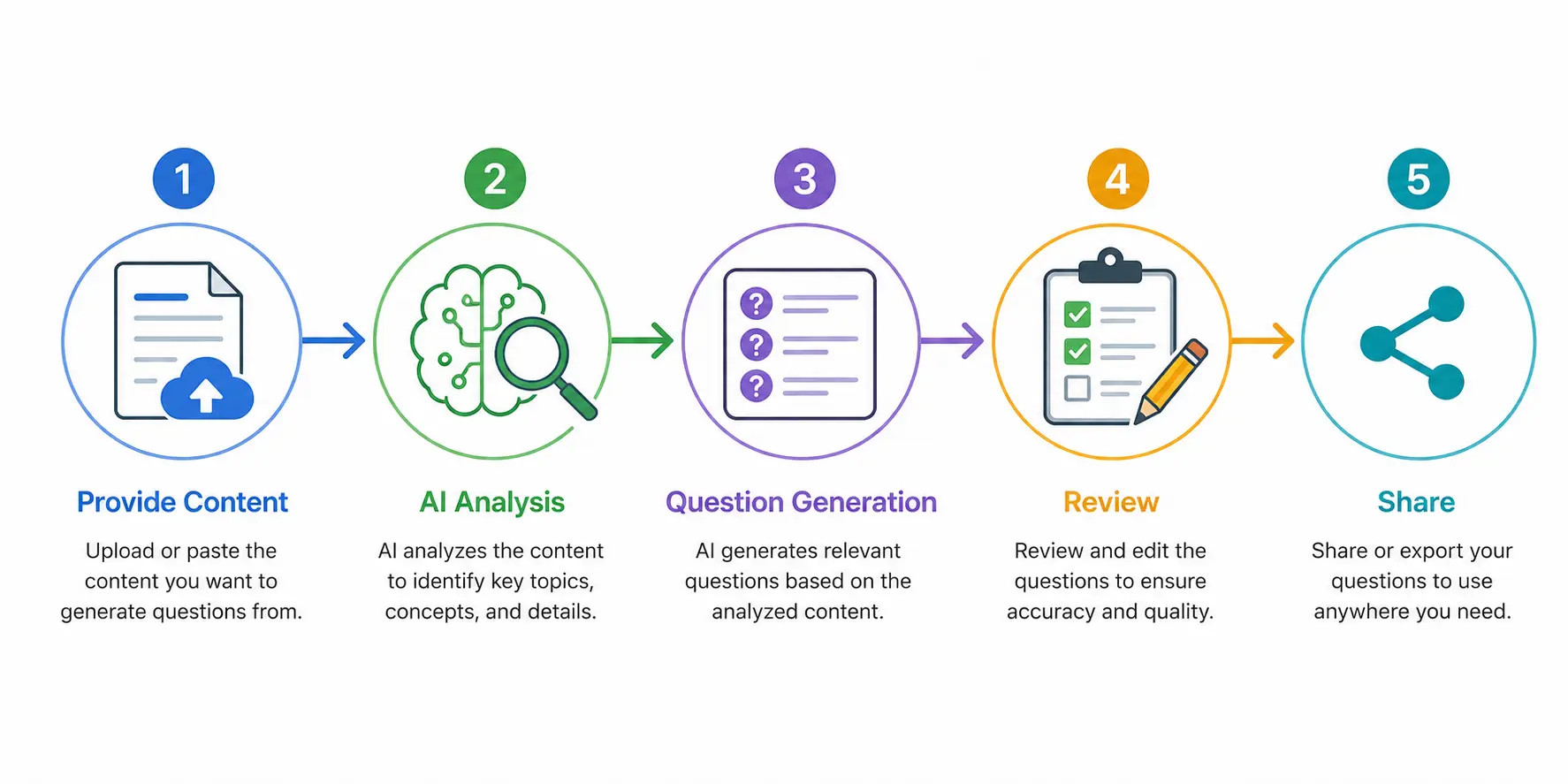
The five-step process: provide content → AI analysis → question generation → review → share
Who Benefits from an AI Question Generator?
| Teachers | Convert lesson materials into formative assessments and exit tickets | 3–5 hours/week |
| Students | Turn lecture notes and textbook chapters into practice tests | 2–4 hours per exam |
| Corporate Trainers | Create compliance and onboarding assessments from internal documents | 5–10 hours per training module |
| Course Creators | Generate quizzes that increase engagement and course completion rates | 10–20 hours per course |
| HR Teams | Evaluate employee understanding of policy and procedure updates | 3–6 hours per policy update |
| Instructional Designers | Rapid-prototype assessment items for learning experience design | 8–15 hours per project |
Teachers
Teachers can transform lesson plans, reading assignments, and instructional materials into formative assessments in minutes. Instead of spending Sunday evenings writing quiz questions, teachers can upload their weekly materials and receive a draft quiz immediately freeing time for lesson planning, differentiation, and one-on-one student support.
Students
Students who use self-testing as a study strategy consistently outperform peers who re-read notes and highlight passages. Converting lecture notes, textbook chapters, and study guides into practice questions turns passive review into active retrieval practice the study technique with the strongest empirical support in the learning sciences.
Corporate Trainers
Training teams managing onboarding programs, compliance training, and skills development can create assessments directly from existing training manuals, policy documents, and internal wikis. This is especially valuable for regulated industries (healthcare, finance, manufacturing) where training materials and assessments must stay synchronized with regulatory changes.
Course Creators
Online educators can generate quizzes that increase course completion rates. Data from Thinkific’s 2025 Learning Trends Report shows that courses with embedded assessments have 25–40% higher completion rates than content-only courses, because quizzes create natural checkpoints that maintain learner momentum and provide a sense of progress.
HR Teams
When company policies or procedures change, HR teams need to verify that employees understand the updates. Automatically generating assessments from policy documents speeds up the compliance verification cycle and creates an auditable record of employee understanding increasingly important for SOC 2, ISO 27001, and other compliance frameworks.
Instructional Designers
Instructional designers can use AI-generated questions to rapidly prototype assessment items during course development, testing multiple question formats and difficulty levels before finalizing assessments. This accelerates the design iteration cycle significantly.
Common Use Cases (with Examples)
Here are eight real-world applications for AI question generation technology:
Lecture notes → formative assessments: A biology professor uploads their 40-slide lecture on cellular respiration and generates a 30-question multiple-choice practice test in under two minutes — giving students same-day retrieval practice.
Textbook chapters → reading checks: A high school history teacher converts each textbook chapter into a 15-question quiz to verify students completed (and understood) the assigned reading before class discussion.
Employee handbooks → compliance assessments: An HR director uploads the company’s updated code of conduct (60-page PDF) and generates a 25-question assessment that every employee must pass annually.
Training manuals → certification quizzes: A manufacturing trainer converts equipment operation manuals into safety certification quizzes, ensuring operators demonstrate knowledge before using machinery.
Online articles → course knowledge checks: A course creator pastes the text of five industry articles and generates end-of-module quizzes that test applied understanding, not just recall of terminology.
Study notes → practice exams: A medical student converts 200 pages of study notes into a question bank organized by body system, creating spaced-repetition practice sessions across the semester.
Web content → lead-generation quizzes: A marketing team generates product-knowledge quizzes from their website content, using quiz results to qualify leads based on demonstrated product understanding.
Research papers → journal club preparation: A graduate program coordinator converts assigned journal articles into guided discussion quizzes that ensure students arrive prepared for seminar with a baseline understanding of the methods and findings.
Lecture notes → formative assessments: A biology professor uploads their 40-slide lecture on cellular respiration and generates a 30-question multiple-choice practice test in under two minutes — giving students same-day retrieval practice.
Textbook chapters → reading checks: A high school history teacher converts each textbook chapter into a 15-question quiz to verify students completed (and understood) the assigned reading before class discussion.
Employee handbooks → compliance assessments: An HR director uploads the company’s updated code of conduct (60-page PDF) and generates a 25-question assessment that every employee must pass annually.
Training manuals → certification quizzes: A manufacturing trainer converts equipment operation manuals into safety certification quizzes, ensuring operators demonstrate knowledge before using machinery.
Online articles → course knowledge checks: A course creator pastes the text of five industry articles and generates end-of-module quizzes that test applied understanding, not just recall of terminology.
Study notes → practice exams: A medical student converts 200 pages of study notes into a question bank organized by body system, creating spaced-repetition practice sessions across the semester.
Web content → lead-generation quizzes: A marketing team generates product-knowledge quizzes from their website content, using quiz results to qualify leads based on demonstrated product understanding.
Research papers → journal club preparation: A graduate program coordinator converts assigned journal articles into guided discussion quizzes that ensure students arrive prepared for seminar with a baseline understanding of the methods and findings.
What to Look for in an AI Question Generator
Not all question generators produce equal results. Here’s what separates effective tools from the rest:
| Feature | Why It Matters |
|---|---|
| Content-aware generation | Questions should reflect the actual source material, not generic templates filled with topic keywords |
| Multiple question types | MCQs test recognition; short-answer tests recall. A mix of both produces stronger learning outcomes |
| Plausible distractors | Poorly generated wrong answers make MCQs too easy and reduce the learning benefit of retrieval practice |
| Multi-format input | Support for PDFs, text, URLs, and documents ensures the tool fits your workflow, not the other way around |
| Processing speed | Large documents (100+ pages) should generate question sets in under 2–3 minutes |
| Editing interface | You should be able to modify, reorder, delete, and change question types before publishing |
| Export options | LMS compatibility (Canvas, Moodle, Google Classroom, SCORM) prevents manual re-entry |
| Batch processing | Enterprise users should be able to process multiple documents simultaneously |
| Result tracking | Built-in analytics show which questions learners struggled with, enabling targeted remediation |
Red Flags to Avoid
- Tools that generate questions without actually analyzing your content (keyword matching only)
- Platforms with no editing capability (you’re stuck with whatever the AI produces)
- Services limited to a single question type
- No export or sharing options (quiz trapped inside the tool)
- No data handling transparency for uploaded content
- Pricing models that charge per question rather than per document or subscription
Generate Questions with AutoQuizBuilder
AutoQuizBuilder makes it easy to transform content into engaging, well-structured questions in a few clicks. Here’s what sets it apart:
- Multi-format input: Upload PDFs, paste text, enter URLs, or submit documents the AI analyzes content regardless of format
- Content-aware generation: The system reads and understands your material before generating questions, producing items that reflect the source content, not generic templates
- Multiple question types: Multiple-choice, true/false, multi-select, fill-in-the-blank, and short-answer formats in a single quiz
- Plausible distractors: AI-generated wrong answers are drawn from related-but-incorrect concepts in your content, making multiple-choice questions genuinely diagnostic
- Fast processing: Most documents are processed and ready for review in under 60 seconds
- Full editing control: Review every question, edit wording, swap question types, adjust difficulty, and reorder before publishing
- Built for collaboration: Share quizzes with colleagues, assign to learner groups, and track results from one dashboard
- LMS export: Compatible with Canvas, Moodle, Google Classroom, and SCORM-compliant platforms
Tip: For best results, provide well-structured content with clear headings and organized sections. The AI performs best when it can identify a logical content hierarchy the same structure that makes content easier for humans to learn from also makes it easier for AI to parse accurately. If you’re working with a PDF, see our guide to preparing content for AI quiz generation.
Frequently Asked Questions
Can AI really create accurate, useful questions?
Yes. Modern AI question generators use natural language processing to identify key concepts, definitions, and relationships within source content. Accuracy depends on three factors: (1) the quality and structure of your source material (well-organized text documents produce the best results), (2) the sophistication of the AI model powering the tool, and (3) whether a human reviews the output. Google DeepMind’s 2024 research on question generation benchmarks found that state-of-the-art models can produce questions rated as indistinguishable from human-written questions in blind evaluation when working with well-structured material. That said, always review AI-generated questions before using them in high-stakes assessments.
Are AI-generated questions accurate enough for graded exams?
For low-stakes formative assessments (practice quizzes, knowledge checks, homework), AI-generated questions are generally accurate enough after a brief human review. For high-stakes summative assessments (final exams, certification tests, compliance evaluations), AI-generated questions should serve as a starting point an efficient first draft that an instructor or subject matter expert reviews and refines. The best workflow uses AI for speed and humans for quality assurance. Plan to spend 5–10 minutes reviewing a 25-question quiz before using it in a graded context.
What types of content produce the best questions?
Structured, text-based content with clear heading hierarchies produces the highest-quality questions. The best results come from:
- Study guides and lecture notes (already organized for learning)
- Training manuals (procedural content with clear concepts)
- Textbook chapters (structured with definitions and key terms)
- eBooks and instructional materials
- Technical documentation with defined terminology
- Well-structured web articles and blog posts
Scanned image-based PDFs, heavily formatted documents (magazine layouts, multi-column academic papers), and content heavy on charts or diagrams may require preprocessing. See our compatibility guide for a full list of supported content types.
How is this different from a PDF-to-quiz converter?
A dedicated PDF to quiz generator is optimized for PDF documents specifically handling multi-column layouts, embedded images, and PDF-specific formatting challenges. A general AI question generator works across multiple content formats: PDFs, pasted text, web URLs, Word documents, and more. If you primarily work with PDFs, a PDF-specific tool may offer deeper format handling. If you work with diverse content sources, a multi-format AI question generator is the better fit. AutoQuizBuilder supports both workflows.
Can I edit questions after they’re generated?
Yes and you should. Every reputable AI question generator includes an editing interface where you can modify question wording, change question types, adjust answer choices, remove questions, and reorder the quiz. AI-generated questions are a time-saving starting point, not a finished product. Plan to spend 5–10 minutes reviewing and refining a 25-question quiz before publishing or assigning it.
How long does it take to create a quiz with AI?
The automated generation phase typically completes in 30–90 seconds for most documents (under 100 pages). Add 5–15 minutes for human review and editing, depending on quiz length and the stakes of the assessment. The total workflow provide content, generate, review, publish is typically 10–20 minutes, compared to the 2–5 hours it would take to write the same quiz manually. For recurring content types (weekly lesson quizzes, monthly compliance checks), the time savings compound significantly.
Is my content secure when I upload it to an AI question generator?
This depends on the tool. Look for platforms that clearly state their data handling practices: SSL/TLS encryption for uploads, deletion policies for processed files, and compliance with relevant regulations (GDPR, FERPA for education tools, SOC 2 for enterprise). Review any tool’s privacy policy and terms of service before uploading sensitive or proprietary content.
What question types should I use for different learning objectives?
The question format should match what you’re assessing:
- Multiple-choice: Best for testing recognition, factual knowledge, and concept discrimination. Efficient to answer and grade.
- True/false: Good for quick knowledge checks and surfacing common misconceptions.
- Short-answer / fill-in-the-blank: Tests recall (not just recognition), requiring learners to retrieve information from memory a stronger learning signal.
- Multi-select: Useful when multiple factors or conditions apply, common in compliance and technical training.
- Open-ended: Best for assessing analysis, synthesis, and applied understanding. Harder to auto-grade but provides the richest insight into learner thinking.
A well-designed assessment often mixes 2–3 question types to test both recognition and recall.
Conclusion
An AI question generator transforms static content into interactive assessments – cutting hours of manual question-writing down to minutes of review. The research is unambiguous: active recall through quizzing is one of the most effective learning strategies available, and AI now makes it practical to create high-quality assessments for every document, every module, and every training session – not just the ones you have time to write questions for.
Whether you’re an educator building formative assessments, a student creating practice tests from study notes, a corporate trainer scaling compliance evaluations, or a course creator adding engagement checkpoints to your curriculum, the right AI question generator saves time, improves learning outcomes, and makes assessment creation sustainable at any scale.
Whether you’re an educator building formative assessments, a student creating practice tests from study notes, a corporate trainer scaling compliance evaluations, or a course creator adding engagement checkpoints to your curriculum, the right AI question generator saves time, improves learning outcomes, and makes assessment creation sustainable at any scale.
Next Steps
Try it yourself: Generate questions from your content in 60 seconds — free trial, no credit card required
PDF-focused workflow: See how our PDF to quiz generator handles complex document formats
This guide draws on established learning science research, including Dunlosky et al. (2013) “Improving Students’ Learning With Effective Learning Techniques” (Psychological Science in the Public Interest) and Karpicke & Blunt (2011) “Retrieval Practice Produces More Learning than Elaborative Studying with Concept Mapping” (Science). For questions or corrections, please contact.